Rust, paint, grease and old coatings build up on almost every metal surface in industry. Removing them has always been messy work, involving abrasives, chemicals or hours of hand scrubbing. Laser cleaning offers a different approach: a beam of light that lifts contamination away while leaving the surface beneath untouched. It sounds almost too neat to be true, yet the process is straightforward, and a good laser cleaning machine manufacturer can explain it in plain terms before you ever switch a machine on.
The Basic Principle
Laser cleaning works through a process called ablation. A pulsed laser beam is aimed at the surface, and the contaminant, rust, paint or oil, absorbs the laser energy far more readily than the clean metal underneath. The contaminant heats up extremely quickly and is lifted away as fine dust or vapour, which is then drawn off by an extraction system. The clean metal below reflects more of the beam and absorbs less energy, so it stays cool and undamaged. The result is a clean surface with no abrasion, no chemicals and no change to the shape of the part. Because the process is so selective, a laser cleaning machine manufacturer can set up a system that removes exactly the unwanted layer and nothing else.
Pulsed Beams and Fine Control
The key to the process is the pulsed beam. Instead of shining continuously, the laser fires in very short bursts, each lasting a tiny fraction of a second. Between pulses, the surface has a moment to cool. This gives the operator precise control: by adjusting the pulse energy, the pulse rate and the speed at which the beam moves, they can clean gently or aggressively as the job requires. A light pass removes fingerprints and thin oxide from a polished mould, while a stronger setting strips thick rust from a steel beam. The operator can also control the width of the cleaning path, working on a narrow line for detail work or a broad sweep for large flat areas.
Why the Surface Stays Safe
One of the first questions people ask is whether the laser damages the metal. The answer lies in the difference between the contaminant and the substrate. Rust and paint absorb the laser’s wavelength readily, while clean steel or aluminium reflects much of it. The cleaning process is tuned so that the contaminant reaches the temperature at which it lifts away, while the metal beneath stays well below any temperature that would change its structure. A responsible laser cleaning machine manufacturer will demonstrate this on your own parts, showing that the surface is clean but its dimensions and finish are unchanged. For very delicate work, such as historic stone or bronze, the settings can be made gentler still.
What a Cleaning System Contains
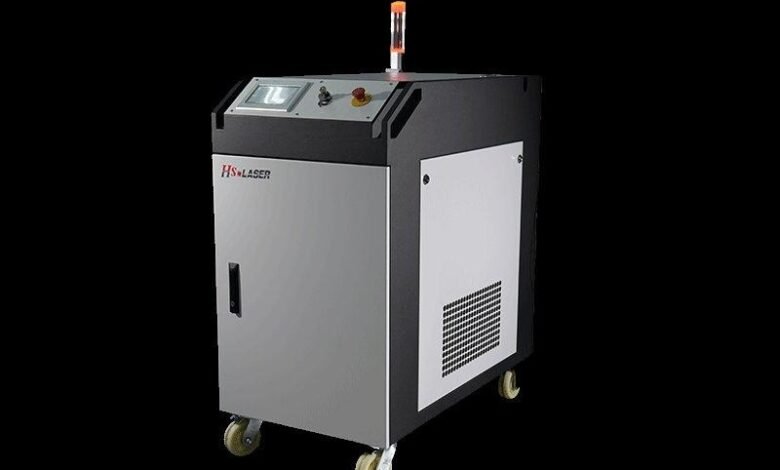
A laser cleaning machine manufacturer supplies more than just a laser source. A handheld cleaning head, often about the size of a small power tool, directs the beam and lets the operator work on parts of any shape. An air-cooled or water-cooled source supplies the pulses. A chiller keeps the system at a stable temperature, and an extraction unit removes the dust and fumes created during cleaning. Many systems are portable, built on wheels or in a compact case, so they can be taken to the workpiece instead of bringing the workpiece to a workshop. The control unit lets the operator choose preset programmes for common jobs, such as rust removal or paint stripping, and adjust them as needed.
Where the Technology Fits Best
Laser cleaning suits jobs where the surface matters. It is used to prepare steel for welding or painting, to clean injection moulds without wearing the polished surface, and to remove rust from machinery, vehicles and structural parts. Conservators use it on stone buildings and bronze statues, where abrasives would cause damage. It is also used to remove coatings from aircraft parts and to clean electrical contacts. A laser cleaning machine manufacturer with experience across these areas can advise which power level and which type of system suits your work, since a machine that is too powerful for delicate parts is as unhelpful as one that is too weak for heavy rust.
See also: Sales Techniques That Close Deals in 2026
5 Advantages of Laser Cleaning
- No abrasives: the surface is cleaned without wear or scratching.
- No chemicals: no solvents, no disposal problems and no residue.
- Precise control: only the unwanted layer is removed.
- Portable systems: the machine comes to the work, not the other way round.
- Clean working: dust and fumes are extracted at the source.
When to Ask an Expert
Laser cleaning is simple in principle, but every material behaves differently. If you are unsure about the right settings for a delicate surface, or if a job is not cleaning as expected, ask the laser cleaning machine manufacturer for advice before experimenting. A good laser cleaning machine manufacturer will test the material, suggest settings and explain why they work. That guidance is part of what you pay for, and using it saves time, avoids damage and builds your team’s confidence with the technology.
Frequently Asked Questions
Does laser cleaning damage the metal underneath?
When set up correctly, no. The contaminant absorbs the energy and lifts away, while the clean metal reflects most of the beam and stays cool. Demonstration on your own parts is the best way to confirm this.
What can laser cleaning remove?
Rust, paint, oil, grease, oxide layers, soot and old coatings. It works on steel, aluminium, stone, bronze and many other materials, depending on the settings.
Is laser cleaning noisy or messy?
It is quieter than sandblasting and far cleaner. The main by-product is fine dust, which the extraction system removes, leaving the work area tidy.
Final Thoughts
Laser cleaning is a simple idea executed with precision: a pulsed beam removes only what should not be there. Once you understand ablation, pulse control and the difference between contaminant and substrate, the technology makes sense. Talk to a laser cleaning machine manufacturer, ask for a demonstration on your own parts, and you will see quickly whether the process fits your work. Ask a laser cleaning machine manufacturer for a demonstration: a good laser cleaning machine manufacturer will test the process on your own parts first.