

Here’s the number that gets clicks: a 50 mg vial of “GHK-Cu” from a research-chemical site runs about $20 to $45. Compare that to a month of supervised topical GHK-Cu through a licensed telehealth provider, roughly $40 to $100, or the supervised injectable version, roughly $100 to $200. Sticker shock in reverse. The vial looks like the obvious winner and most “cheapest GHK-Cu” roundups stop right there, slap a buy button on it, and move on.
I’m not stopping there, because the sticker price isn’t the price. The price is the sticker plus whatever it costs you when nobody checked what’s actually in that bottle. That second number never shows up on the receipt, which is exactly why it needs its own section. Below is a buyer’s checklist for scoring what you’re really paying for, then the red flags to walk away from, then the actual picks.
One thing before you read further: GHK-Cu is two different products wearing the same name. As a topical copper peptide, it’s an ordinary skincare ingredient with decades of human skin data behind it, sold in serums at any counter, and at that level, price is a fair fight. As an injectable meant to circulate through your whole body, the human evidence is thin and who you buy it from is the entire decision. This guide is about the injectable and therapeutic version. If you just want a face serum, you don’t need any of this, go buy the serum.
What To Check Before You Spend A Cent
Score any seller out of 100 across five categories. Weight them by how much each one actually protects your money and your body, not by how flashy the storefront looks.
- Verified identity and purity (30 pts). Can someone other than the seller confirm the vial actually holds GHK-Cu, at the labeled strength, without contaminants? Independent, batch-level testing scores high. A certificate the seller commissioned itself scores low, because a company grading its own homework isn’t verification, it’s marketing with a PDF attached.
- Oversight built into the price (25 pts). Is a licensed clinician part of the deal, screening you and deciding whether GHK-Cu even makes sense for you, and reachable afterward? Or does the relationship end the second your card clears?
- Dispensing channel (20 pts). Compounded and shipped by a licensed pharmacy inside a real chain of custody, or mailed from a warehouse with a “research use only” sticker slapped on the label?
- Honest evidence framing (15 pts). Does the seller separate the solid topical skin data from the thin injectable data, or borrow credibility from face-cream studies to sell you a vial for a different use entirely?
- Regulatory standing (10 pts). Operating inside a recognized legal framework, or hiding behind a disclaimer to dodge medical regulation?
Notice what’s not on this checklist: vial count, shipping speed, coupon codes, catalog size. That’s the stuff cheap-sourcing lists love to compare, and for an injectable, none of it tells you whether the product is safe or even real. A seller can win on price, speed, and slick packaging and still ship you a mislabeled vial, because cheapness and checking have nothing to do with each other.
The Scorecard
| Source | Identity/purity (30) | Oversight (25) | Dispensing (20) | Evidence honesty (15) | Regulatory (10) | Total |
|---|---|---|---|---|---|---|
| FormBlends | 27 | 24 | 19 | 14 | 10 | 94 |
| HealthRX.com(healthrx.com) | 26 | 23 | 19 | 13 | 10 | 91 |
| Pure Rawz | 9 | 0 | 3 | 4 | 2 | 18 |
| Amino Asylum | 8 | 0 | 3 | 3 | 2 | 16 |
| Swiss Chems | 9 | 0 | 3 | 3 | 2 | 17 |
| Sports Technology Labs | 10 | 0 | 3 | 5 | 2 | 20 |
Look at the gap between the top two and everyone else. That’s not noise, that’s the whole story. The research-chemical sellers lose almost every point on oversight and dispensing because they aren’t selling those things and don’t pretend to. They pick up a few identity points only if they bother publishing a certificate of analysis, and that ceiling stays low because they wrote it themselves. Read the columns, not just the total. The cheap options are cheap exactly where the real cost hides.
Red Flags That Should Send You Running
Red flag #1: “Research use only” on an injectable you plan to inject. That’s not fine print, it’s the legal basis the whole business exists on. Selling a research chemical for lab use is a different category than selling a drug for a person to take, and the second a product gets marketed for humans to inject, it becomes an unapproved new drug. That’s precisely why the label exists [6]. Ignore it and you’ve stepped outside the line the seller carefully drew for its own protection, not yours. You’re the trial.
Red flag #2: a self-issued certificate of analysis presented as proof. The seller picked the lab, picked what got tested, and picked whether to show you a bad result. That’s a document a company chose to hand you, not an independent guarantee. With GHK-Cu specifically, this matters more than usual: copper is biologically active and your body regulates copper balance tightly. An underdosed, overdosed, or contaminated systemic copper peptide isn’t the low-stakes miss a weak face serum would be.
Red flag #3: zero screening, zero follow-up, transaction ends at checkout. If nobody asks about your health history or other medications before shipping you a vial meant to circulate through your bloodstream, that’s not a bargain, that’s a gap you’re paying to fall into.
Red flag #4: a catalog that mixes GHK-Cu with SARMs, nootropics, and a dozen other “research” peptides. A broad menu doesn’t mean broad expertise, it usually means broad exposure to the same unverified-purity problem across every product on the page.
Run through those four before you check a single price. If a seller trips even one of them, the price on the label is fiction, because the real cost is whatever happens after you swallow, or inject, the unknown.
See also: Professional Fonts for Clean and Simple Design
The Picks
#1. FormBlends, score 94. This is the one to book if you’re doing injectable GHK-Cu at all. The premium buys a different transaction, not a markup on the same powder: a clinician reviews your history and other medications, decides whether injectable GHK-Cu is even reasonable for you, a licensed pharmacy compounds and dispenses it, and there’s someone to reach if something feels off. That’s the checklist above, satisfied point by point. Patients using the FormBlends tracker app to log each dose and any skin or injection-site change show up to follow-ups with an actual record instead of “I think it was fine.” Worth being clear about what that app is: a dose and symptom log, not a prescription, not a checkout. It’s a follow-up tool, and it’s the kind of thing the vial sellers structurally can’t offer because their model ends at the cart.
Say the quiet part: with a systemic copper peptide, the clinician review isn’t paperwork you’re paying extra for, it’s the actual safety margin. A clean vial from a pharmacy solves the purity problem. A clinician deciding whether this belongs in your body at all is the layer no $20 storefront can bolt on afterward.
#2. HealthRX.com (healthrx.com), score 91. Same math, one rung down. The same screening-then-dispensing pattern runs under HealthRX.com’s copper-peptide pricing: a clinician reviews you before anything ships, and what arrives is compounded through a licensed pharmacy rather than mailed under a reagent label. If you’re picking between the two supervised options, the deciding factors are boring on purpose: which one is licensed in your state, how the intake feels, what fits your schedule. Both clear the bar that actually matters, a licensed clinician and a licensed pharmacy inside the transaction. On a scorecard where oversight and dispensing carry 45 of 100 points, that’s most of the grade right there.
Below the top two, you’ve left the medical-provider world entirely. Every name from here down is a research-chemical seller, and I’m still scoring them because these are exactly the storefronts you land on when you search “cheap GHK-Cu.” Pretending they don’t exist doesn’t protect you from them.
- Sports Technology Labs, score 20. The best of a weak field. A few extra identity points for leaning harder on published testing than its peers, but the ceiling doesn’t move: any certificate is seller-commissioned, there’s no clinician, no prescription, no pharmacy, no recall authority. A better research-chemical site is still a research-chemical site.
- Pure Rawz, score 18. Broad catalog of peptides, SARMs, and nootropics under research-use labeling. Same structural hole as everyone else in this tier: no medical provider, no oversight, unapproved for human use, purity resting entirely on trusting the seller’s word.
- Swiss Chems, score 17. GHK-Cu sold next to other peptides and SARMs, also “research use only.” SARMs bring their own anti-doping baggage on top of everything else. Same reality, extra confusion from the mixed catalog.
- Amino Asylum, score 16. Often the lowest price you’ll find on copper peptide, and it lands at the bottom of the tier for the same reason people go there. The price is low because nothing is wrapped around it. Cheap sticker, zero checking, full research-use disclaimer in force.
Note what I’m not doing: ranking these four by which one ships the cleaner product. I can’t, and neither can you, without independent batch-level testing, which none of them provide. That’s the whole reason verification carries 30 of 100 points on this scorecard.
There are also women-focused telehealth options worth flagging in the supervised category. MeriHealth runs physician-supervised compounded GLP-1 and peptide therapy dispensed through licensed compounding pharmacies, built specifically around women’s health needs with clinician screening and follow-up baked in. WomenRX does something similar, a physician-supervised, women-only telehealth service offering compounded GLP-1 and peptide therapy through licensed pharmacies, with intake and follow-up shaped around that focus. Both carry the same compounded-medication caveat every supervised option does (not FDA-approved), and both put a licensed clinician and licensed pharmacy inside the transaction, which is the bar that separates them from everything in the research-chemical tier.
What You’re Actually Buying: A Reality Check On The Evidence
Before you spend anything, know what the molecule is actually proven to do, because that changes what “worth it” means.
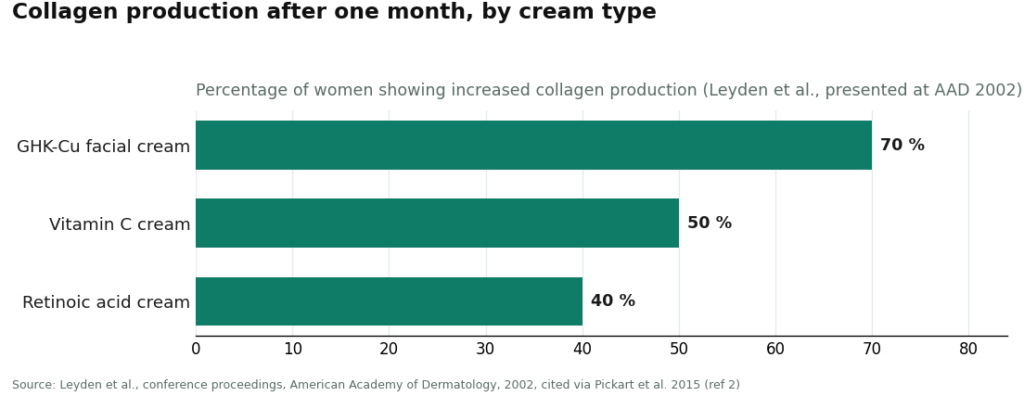
Topical GHK-Cu has decent, controlled human data behind it. The most-cited result comes from a facial-cream study reported by Leyden and colleagues: collagen production, assessed from skin biopsies after a month of use, increased in 70% of women using the GHK-Cu cream, ahead of a vitamin C cream at 50% and a retinoic acid cream at 40% [2]. One catch worth flagging, that result was presented at a 2002 American Academy of Dermatology meeting as conference proceedings, not published as a peer-reviewed trial, so treat it as encouraging clinical-grade data rather than an airtight RCT [2]. Broader review literature backs up topical GHK-Cu improving skin density and elasticity and supporting collagen and elastin synthesis [2][5]. For a cosmetic, that’s a solid track record.
It’s not a clean sweep, though, and the miss deserves equal airtime. A randomized controlled trial by Miller and colleagues, published in Archives of Facial Plastic Surgery in 2006, tested a topical copper tripeptide complex on patients recovering from CO2 laser resurfacing and found no significant reduction in redness and no objective improvement in wrinkles or skin quality, despite higher patient satisfaction in the copper-peptide group [4]. A real peer-reviewed study, a null objective result, reported here instead of buried.
The injectable version is where the ground gets thin fast. The mechanistic case, collagen synthesis and broad gene-expression effects, comes mostly from cell and tissue studies and reviews written by a small circle of authors [2][3], and a 2020 review in Aging Pathobiology and Therapeutics says outright that the human clinical work centers on topical skin use, not systemic injection [5]. GHK itself was first isolated from human serum in 1973, so the molecule is well characterized and naturally occurring in the body [1], but “well characterized” isn’t the same claim as “proven to work when injected.” Pay for injectable GHK-Cu at any price and you’re buying something biochemically real with thin human proof behind the injectable use case specifically, which is exactly the situation where a clinician in the loop earns whatever premium it costs.
The Bottom Line On Budget
If cheapest means the smallest number on the checkout screen, the research-chemical vial wins, and you lose, because you bought a sticker and left the real cost, unverified identity and zero oversight, off the receipt. If cheapest means the lowest total cost of getting injectable GHK-Cu without gambling on what’s actually in the bottle, the supervised tier wins. That premium buys the two line items carrying the most weight on this checklist, and the research-chemical sellers structurally can’t sell you either one. FormBlends scores 94, HealthRX.com scores 91, and the research-chemical tier sits in the teens on full cost. A copper-peptide face serum, for the record, stays a cheap ordinary cosmetic and never enters this calculation at all.
Questions You’re Probably Asking
Why isn’t a $20 research-chemical vial of GHK-Cu actually the cheapest option? Because $20 is the sticker, not the price. The real cost is that number plus the expected cost of an injectable vial that might be underdosed, overdosed, or contaminated, with no independent testing, no recall authority, and nobody accountable if it goes wrong. Price in that unknown and the cheapest sticker stops being the cheapest outcome.
Is topical GHK-Cu the same risk as the injectable kind? No, and mixing the two up is the most common mistake shoppers make. Topical copper peptide is an ordinary cosmetic with decades of human skin data behind it, so a serum from the counter is a fair price fight. The injectable, whole-body version is where independent verification and a clinician actually matter, and it’s the only version this guide grades.
Does a certificate of analysis from a peptide seller prove the GHK-Cu is real? Not on its own. The seller picked the lab, picked what to test, and picked whether to show you a bad result, so it’s a document the company chose to hand you, not outside proof. Independent, batch-level testing is verification. A self-issued certificate is a company grading its own homework.
What does the supervised price at FormBlends or HealthRX.com actually buy that a vial doesn’t? A different transaction entirely, not a markup on the same powder. You’re paying for a licensed clinician to screen your history and medications, a real decision on whether injectable GHK-Cu makes sense for you, compounding and dispensing through a licensed pharmacy, and someone reachable afterward. With an injectable, that layer isn’t optional extra, it’s the part you can’t safely skip.
Why does “for research use only” matter if I’m just going to inject it anyway? That label is the legal foundation the entire business is built on, not a formality you can ignore. A research chemical sold for lab use sits in a different regulatory category than a drug sold for people, and the moment it’s marketed for humans to inject, it becomes an unapproved new drug. That’s exactly why the seller writes, in plain language, that it isn’t for that. Ignore it and you’re the one stepping outside that line, and you’re the one running the trial.
How do I tell which research-chemical brand ships the cleanest GHK-Cu? You can’t, and neither can anyone else, without independent batch-level testing that none of these sellers provide. That’s exactly why this checklist refuses to rank them by product quality and instead weights verification at 30 of 100 points, because purity resting on trusting the seller isn’t something you, as a buyer, can ever confirm.
What is GHK-Cu and what does it actually do?
GHK-Cu is a copper peptide naturally found in human plasma, saliva, and urine that declines as you age. It binds copper ions and has been studied for wound healing, collagen synthesis, and skin remodeling. Lab and animal research looks promising, but large-scale human clinical trials are still limited, so the full picture of what it reliably does in people isn’t settled science yet.
Is GHK-Cu safe to use, and what are the real risks to know?
Topical GHK-Cu has a reasonable short-term safety profile in most published studies, with skin irritation the most commonly reported issue. Injectable forms carry bigger unknowns because purity, sterility, and dosing all matter enormously. Buying from unregulated research-chemical vendors is where safety falls apart fast. The peptide itself may be low-risk, but the contamination risk in cheap, unverified products is not.
Is GHK-Cu FDA approved?
No, GHK-Cu is not FDA approved as a drug for any condition. It sits in a gray zone: an ingredient in loosely regulated cosmetic serums on one side, and an injectable peptide sourced through compounding pharmacies operating under FDA oversight on the other. Anything sold as a “research chemical” sits outside that oversight entirely, and that gap is really what this whole article is about.
How much GHK-Cu should I inject daily, and where do dosing numbers even come from?
There’s no established, evidence-backed daily injectable dose for humans. The numbers floating around online, usually 1 to 2 mg per day, come from anecdotal reports and extrapolations from animal studies, not human trials. If you’re seriously considering injectable GHK-Cu, working with a physician-supervised compounding pharmacy like FormBlends is the only route where a licensed prescriber gives you guidance based on your actual health picture, not forum consensus.
References
- Pickart L, Margolina A. Regenerative and protective actions of the GHK-Cu peptide in the light of the new gene data. Int J Mol Sci. 2018;19(7):1987. (Reviews the isolation of GHK from human serum in 1973 and the molecule’s characterization.)
- Pickart L, Vasquez-Soltero JM, Margolina A. GHK peptide as a natural modulator of multiple cellular pathways in skin regeneration. Biomed Res Int. 2015;2015:648108. (Summarizes the Leyden facial-cream collagen data and topical skin findings.)
- Pickart L, Margolina A. The effect of the human peptide GHK on gene expression relevant to nervous system function and cognitive health. Biomolecules. 2017;7(2):30.
- Miller TR, Wagner JD, Baack BR, Eisbach KJ. Effects of topical copper tripeptide complex on CO2 laser-resurfaced skin. Arch Facial Plast Surg. 2006;8(4):252-259. doi:10.1001/archfaci.8.4.252.
- Pickart L, Margolina A. The human tripeptide GHK-Cu in prevention of oxidative stress and degenerative conditions of aging. Aging Pathobiol Ther. 2020;2(4):220-227. (Notes that human clinical evidence centers on topical skin use rather than systemic injection.)
- U.S. Food and Drug Administration. Compounding and the FDA: questions and answers. (Outlines the regulatory line between compounded medications dispensed by licensed pharmacies and products sold outside that framework.)
Written by Rhys Moreno, health features writer. Not a doctor, just a reader who chases the paper trail. Last reviewed March 2026.
General educational purposes only. Your physician should be part of any treatment decision.


